

Blog
Epoxy Resin Flooring Cost vs Tiles and Varnish: Which Option Gives Better Long-Term Value?

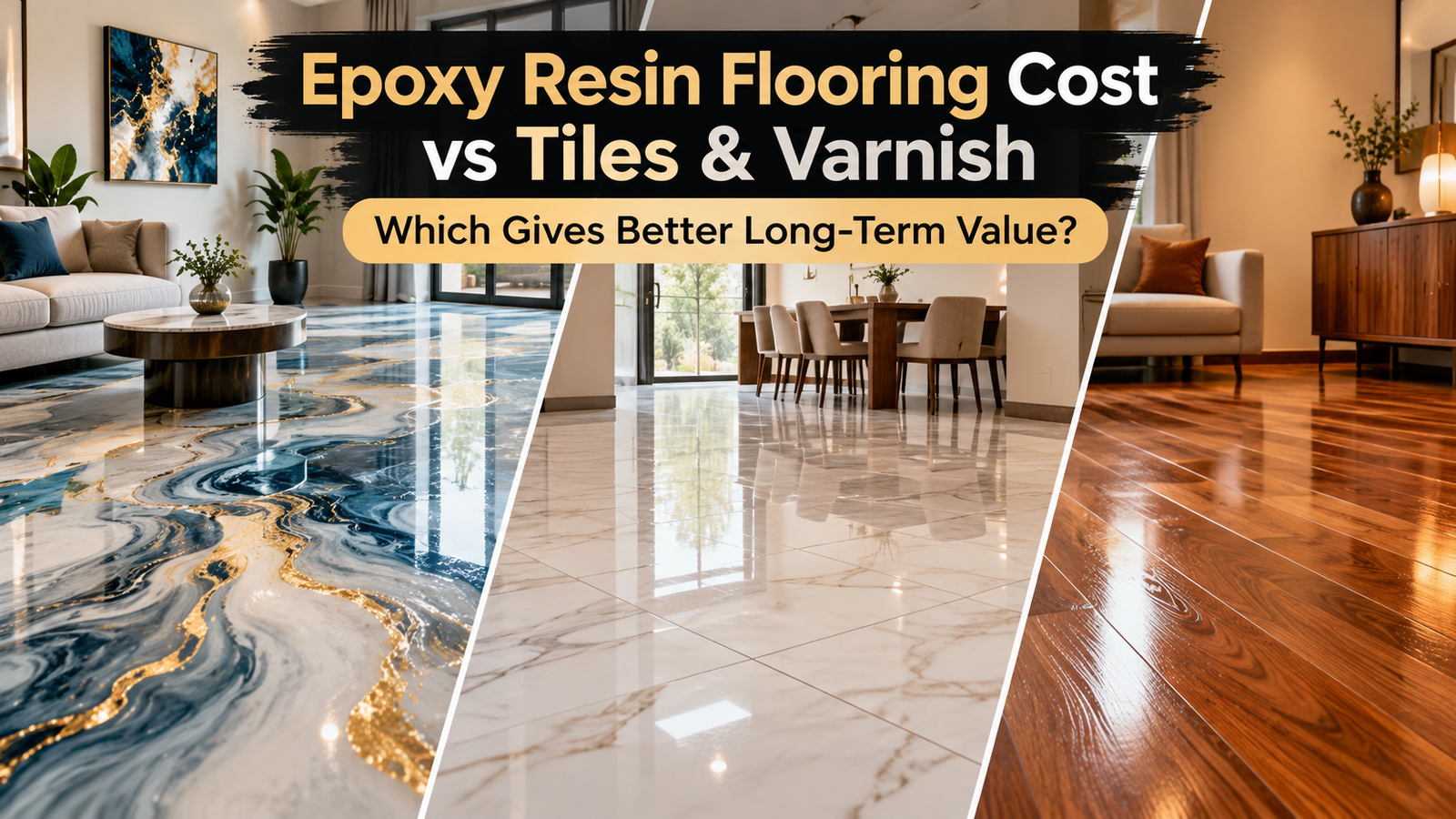
Epoxy Resin Flooring Cost vs Tiles & Varnish
Which Gives Better Long-Term Value?
When planning a new floor or renovating an existing space, one of the first questions homeowners, interior designers and business owners ask is:
“How much does epoxy resin flooring cost?”
The answer isn’t as simple as quoting one price per square foot. Epoxy flooring cost depends on the type of epoxy system, floor condition, thickness, design, surface preparation and the level of finish required.
But there’s another question that is even more important:
Is epoxy flooring actually better value than traditional tiles or a varnished floor over the long term?
For some spaces, tiles may be the practical choice. For others, varnish or conventional flooring may make sense. But when you want a seamless, highly customisable, durable and premium-looking surface, epoxy resin flooring can offer excellent long-term value.
At KorEpox Arts, we look at flooring as more than just a surface. It is an important part of the overall interior design. From subtle marble-effect finishes to metallic designs, artistic flooring and customised resin surfaces, the objective is to create a floor that complements the personality of the space.
Let’s compare the three options in detail.
What Is Epoxy Resin Flooring?
Epoxy flooring is a seamless floor system created by combining epoxy resin with a hardener and applying it over a properly prepared surface.
Depending on the project, the system can include:
-
Surface preparation
-
Primer
-
Base coat
-
Self-levelling epoxy
-
Decorative pigments or metallic effects
-
Artistic resin designs
-
Anti-slip additives
-
Protective topcoat
Unlike tiles, which are installed as individual pieces, epoxy creates a continuous surface with minimal visible joints.
This gives epoxy flooring its distinctive smooth and uninterrupted appearance.
It can be used in:
-
Living rooms
-
Bedrooms
-
Kitchens
-
Garages
-
Offices
-
Showrooms
-
Restaurants
-
Retail spaces
-
Studios
-
Hotels
-
Commercial interiors
-
Selected industrial environments
The exact system should always be selected according to the expected traffic, moisture conditions, chemical exposure and desired appearance.
How Much Does Epoxy Resin Flooring Cost in India?
One of the biggest mistakes when researching epoxy flooring cost per sq ft in India is assuming that every epoxy floor costs the same.
It doesn’t.
Published 2026 Indian market guides show epoxy flooring ranging from approximately ₹40 to ₹400+ per sq. ft., depending on the system, thickness, substrate preparation and finish. Decorative and highly customised systems can move beyond standard coating rates.
A useful planning range is:
| Epoxy Flooring Type | Indicative Cost* | Typical Application |
|---|---|---|
| Basic epoxy coating | ₹40–₹70/sq. ft. | Garages, utility areas |
| Self-levelling epoxy | ₹70–₹150/sq. ft. | Homes, offices, retail |
| Decorative epoxy | ₹150–₹350+/sq. ft. | Premium interiors |
| Heavy-duty systems | ₹150–₹250+/sq. ft. | Industrial/commercial use |
| Highly customised artistic flooring | Project-specific | Luxury interiors |
*Indicative market ranges for planning purposes only. Actual pricing depends on site conditions, materials, preparation, design, thickness, area and specification.
For example, a 500 sq. ft. floor could have a substantially different final cost depending on whether you choose a basic coating or a decorative, multi-layer resin design.
This is why a professional flooring quotation should not simply say:
“Epoxy flooring – ₹X per sq. ft.”
A good quotation should explain what you are actually getting for that price.
What Determines Epoxy Resin Flooring Cost?
Several factors can change the final project price.
1. Floor Area
Larger projects may have better material and labour efficiencies, while smaller projects can sometimes have higher effective per-square-foot costs because of minimum setup and preparation requirements.
For example:
500 sq. ft. × ₹150/sq. ft. = ₹75,000
But that should be treated as a planning calculation rather than a final quote.
2. Condition of the Existing Floor
This is one of the most important factors.
Epoxy flooring performs best when applied over a properly prepared substrate.
If the existing floor has:
-
Cracks
-
Moisture problems
-
Uneven areas
-
Oil contamination
-
Loose coatings
-
Damaged concrete
-
Old adhesive
-
Surface contamination
additional preparation may be required.
Grinding, crack repair, cleaning, priming and moisture correction can significantly affect the project cost.
In other words, the cheapest epoxy quote isn’t necessarily the cheapest complete project.
3. Thickness of the Flooring System
Epoxy flooring can be installed using different system thicknesses.
A thin coating system and a thicker self-levelling or heavy-duty system are not equivalent.
Generally:
More material + more layers + greater performance requirements = higher cost.
For high-traffic commercial or industrial environments, the specification may need to be significantly different from a decorative residential floor.
4. Design and Decorative Effects
This is where epoxy becomes particularly interesting for premium interiors.
A simple solid-colour epoxy floor will generally cost less than a highly customised artistic floor.
Design possibilities can include:
-
Marble effects
-
Metallic effects
-
Stone effects
-
Geode-inspired patterns
-
Ocean-inspired designs
-
Abstract artistic patterns
-
Custom colour combinations
-
Gloss or matte finishes
-
Decorative flakes
-
Custom borders and patterns
The more detailed the artistic work, the more the project becomes a custom interior design installation rather than a standard flooring application.
5. Finish and Protective Topcoat
The final appearance and protection of an epoxy floor can also influence the price.
Depending on the project, you may choose:
-
High-gloss
-
Satin
-
Matte
-
Anti-slip
-
UV-resistant systems
-
Chemical-resistant systems
-
Protective topcoats
The right finish should be selected based on both appearance and how the floor will actually be used.
Epoxy Flooring vs Tiles: Which Is Better?
Tiles remain one of the most popular flooring choices in India—and for good reason.
They are available in a huge range of colours, patterns and price points.
Current 2026 pricing guides put installed ceramic flooring at roughly ₹60–₹100 per sq. ft., vitrified flooring around ₹80–₹160 per sq. ft., and porcelain flooring around ₹105–₹190 per sq. ft., depending on material and installation.
But comparing only the initial price doesn’t tell the whole story.
| Factor | Epoxy Flooring | Tiles |
|---|---|---|
| Seamless appearance | Excellent | No |
| Grout joints | Minimal/none | Yes |
| Design customisation | Very high | High |
| Installation over suitable existing floor | Possible | Often requires preparation/removal |
| Repair | Local repair may be possible depending on damage | Individual tiles can be replaced |
| Cleaning | Easy | Easy, but grout requires attention |
| Artistic designs | Excellent | Limited by available tile designs |
| Waterproof surface | System-dependent | Generally highly water resistant |
| Premium custom appearance | Excellent | Depends on tile selection |
| Initial cost | Moderate to high for premium systems | Low to very high |
| Customisation | Extremely flexible | Product-dependent |
The biggest difference?
Tiles are selected. Epoxy can be created.
If you want a specific colour combination, metallic movement, marble appearance or artistic pattern, epoxy provides significantly more freedom.
Epoxy Flooring vs Varnished Flooring
Varnish is generally used as a protective finish over a suitable surface, particularly wood.
It is therefore not always a direct substitute for epoxy flooring.
A varnished wooden floor provides a completely different aesthetic:
Warm, natural and traditional.
Epoxy provides a different visual language:
Modern, seamless, contemporary and highly customisable.
For wooden surfaces that require refinishing, 2026 published Indian guides put full wood sanding and polishing around ₹70–₹150 per sq. ft., while a simpler recoat can be approximately ₹35–₹70 per sq. ft.
The right choice therefore depends heavily on the surface underneath.
Choose varnish when:
-
You already have good-quality wooden flooring.
-
You want to preserve the natural wood appearance.
-
You prefer a warm and traditional interior.
-
The existing wood is suitable for refinishing.
Consider epoxy when:
-
You want a seamless floor.
-
You want a modern luxury appearance.
-
You want custom colours or artistic effects.
-
You want minimal visible joints.
-
You are working with a suitable concrete or compatible substrate.
A Simple Cost Example
Suppose you have a 500 sq. ft. room.
A simplified planning comparison might look like this:
| Flooring Option | Example Planning Rate | Approx. Project Cost |
|---|---|---|
| Ceramic tiles | ₹60–₹100/sq. ft. | ₹30,000–₹50,000 |
| Vitrified tiles | ₹80–₹160/sq. ft. | ₹40,000–₹80,000 |
| Self-levelling epoxy | ₹70–₹150/sq. ft. | ₹35,000–₹75,000 |
| Decorative epoxy | ₹150–₹350+/sq. ft. | ₹75,000–₹1,75,000+ |
| Artistic/custom epoxy | Custom quotation | Project-specific |
These figures are illustrative planning ranges, not quotations. Tile prices, epoxy systems and labour vary considerably by city, floor condition, project size and specification.
And this is precisely why comparing a ₹70 tile with a ₹200 decorative epoxy floor purely on price can be misleading.
They are solving different design and performance requirements.
So, Is Epoxy Flooring Worth the Money?
For the right project, yes.
But epoxy isn’t automatically the best choice for every floor.
If your primary goal is the lowest possible initial flooring cost, economical tiles may win.
If your priority is preserving natural wood, refinishing the existing wooden floor with an appropriate finish may be the better option.
But if your priorities are:
-
Seamless aesthetics
-
Premium appearance
-
Custom design
-
Easy everyday cleaning
-
Modern interiors
-
Artistic finishes
-
Design flexibility
then epoxy flooring can provide considerably more design value.
The key is to select the right epoxy system for the application, rather than choosing a floor based purely on the lowest price per square foot.
Why Professional Surface Preparation Matters
A beautiful epoxy floor starts long before the resin is poured.
At KorEpox Arts, we believe the preparation stage is just as important as the visible design.
The process can involve:
Step 1 — Site Assessment
The existing floor is evaluated for condition, level, cracks, moisture and suitability.
Step 2 — Surface Preparation
The substrate is cleaned and prepared so that the coating can properly bond.
Step 3 — Repairs
Where required, cracks, damaged areas and surface defects are addressed.
Step 4 — Primer
The appropriate primer/system is applied according to the substrate.
Step 5 — Base System
The main epoxy flooring layers are installed.
Step 6 — Decorative Design
For customised projects, colours, pigments, metallic effects or artistic patterns are incorporated.
Step 7 — Finishing
The floor is finished according to the desired appearance and functional requirements.
Step 8 — Final Inspection
The finished surface is inspected before handover.
The exact sequence varies according to the flooring specification.
Why Choose KorEpox Arts for Epoxy Flooring?
At KorEpox Arts, we approach resin flooring from an artistic as well as technical perspective.
Our expertise isn’t limited to flooring.
We also create custom epoxy furniture and resin décor, allowing you to develop a coordinated interior rather than treating every element separately.
Depending on your project, your flooring can be designed to complement:
-
Epoxy dining tables
-
Resin coffee tables
-
Conference tables
-
Resin wall art
-
Custom nameplates
-
Decorative pieces
-
Bespoke interior installations
This creates an opportunity to build a consistent design language throughout the space.
Imagine a living room where the flooring carries a subtle marble-resin effect and the centre table uses complementary metallic resin details.
Or an office where the floor, reception feature and custom conference table share the same colour palette.
That is where resin becomes more than a flooring material.
It becomes part of the interior identity.
How to Get an Accurate Epoxy Flooring Quote
Instead of asking only:
“What is your epoxy flooring price per sq. ft.?”
provide your flooring contractor with:
-
Total floor area
-
Location
-
Photos/videos of the existing floor
-
Type of property
-
Expected foot traffic
-
Preferred colour
-
Gloss or matte preference
-
Desired design
-
Whether the existing floor needs removal
-
Any known moisture or leakage issues
This allows the flooring professional to determine the appropriate system.
For a customised KorEpox Arts quotation, a site assessment may be recommended before the final price is confirmed.
Frequently Asked Questions About Epoxy Resin Flooring Cost
What is the epoxy flooring cost per sq. ft. in India?
Depending on the system, published 2026 market ranges can run from around ₹40 to ₹400+ per sq. ft. Basic coatings are considerably cheaper than decorative, self-levelling or heavy-duty systems.
For a customised residential or artistic floor, the final quotation should be based on the actual design and site conditions.
Is epoxy flooring more expensive than tiles?
It can be.
Basic tiles may cost less initially, while premium decorative epoxy can cost more. However, the two offer very different aesthetics and installation characteristics.
The better question is:
“Which flooring gives the best value for the way I use my space?”
Can epoxy flooring be installed over existing tiles?
In some situations, epoxy systems can be applied over existing tiles after appropriate assessment and preparation. However, this should never be assumed without inspecting the existing surface.
The tiles must be stable, suitable and properly prepared for the proposed system.
Is epoxy flooring suitable for homes?
Yes. Epoxy flooring can be used in residential interiors when the appropriate system is selected and installed correctly.
It can be particularly effective in modern living spaces, kitchens, garages, studios and other areas where a seamless surface is desired.
Is epoxy flooring slippery?
A glossy epoxy floor can become slippery when wet. For areas where slip resistance is important, an appropriate anti-slip texture or additive should be incorporated into the flooring system.
How long does epoxy flooring last?
The service life depends on the system, substrate preparation, traffic, UV exposure, chemicals, maintenance and installation quality.
A properly specified commercial system can have a long service life, but no responsible contractor should promise a single universal lifespan for every epoxy floor.
Is epoxy flooring easy to clean?
One of its advantages is its seamless surface.
With fewer joints and grout lines than tiled flooring, routine cleaning can be straightforward when the correct finish and maintenance practices are used.
Final Verdict: Which Flooring Gives Better Long-Term Value?
There is no single flooring material that wins every project.
Choose Tiles if:
Your priority is:
Affordable installation + huge product selection + familiar maintenance.
Choose Varnished Wood if:
Your priority is:
Natural warmth + authentic wood appearance + preservation of an existing timber floor.
Choose Epoxy if:
Your priority is:
Seamless luxury + custom design + modern aesthetics + a highly personalised finish.
And for homeowners, architects, interior designers and businesses looking for something beyond an ordinary floor, that’s where epoxy becomes particularly compelling.
You’re not simply buying flooring. You’re creating a surface that can become part of the design.
Looking for Epoxy Flooring in Kolkata?
If you’re planning an epoxy flooring project in Kolkata or elsewhere in India, KorEpox Arts can help you explore the right design and flooring approach for your space.
Whether you are looking for a subtle marble-inspired finish, a sophisticated metallic floor, a custom artistic design or a coordinated resin interior, we can help you develop a solution around your requirements.
Have a floor area, design idea or reference image in mind?
Share your floor dimensions + photos + preferred design, and get a project-specific assessment and quotation from KorEpox Arts.