

Blog
How to Choose and Maintain Epoxy Flooring for Luxury Interiors

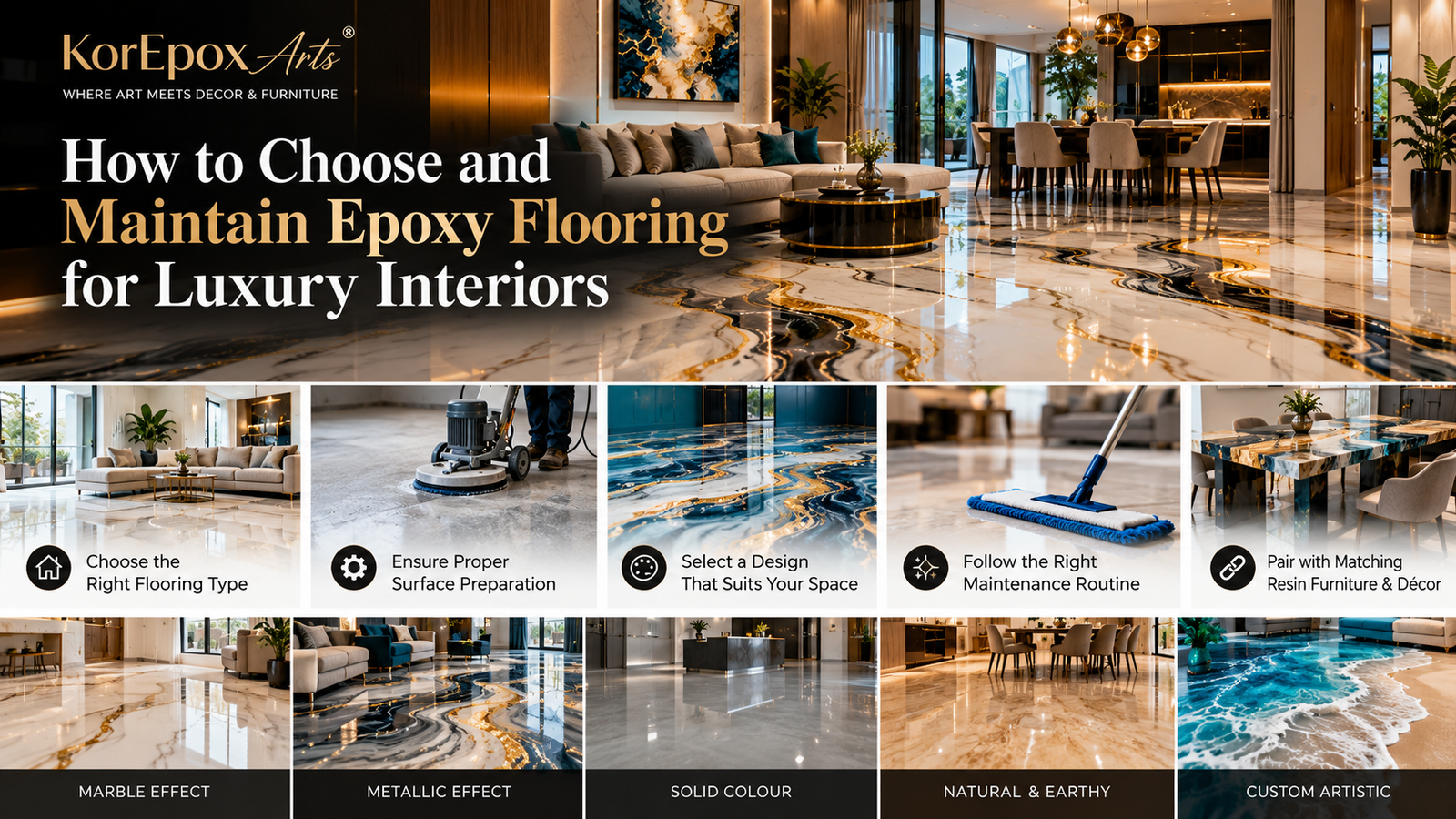
How to Choose and Maintain Epoxy Flooring for Luxury Interiors
Luxury interiors are no longer defined only by expensive furniture, statement lighting or designer walls. Today, the floor itself can become one of the most striking elements of an interior.
This is where epoxy flooring has transformed the possibilities of modern interior design.
Unlike conventional flooring options, epoxy can create a seamless surface with colours, metallic effects, marble-inspired patterns, artistic textures and custom designs. When properly specified and installed, it can combine visual impact with durability and relatively straightforward day-to-day maintenance.
But choosing epoxy flooring for a luxury interior isn’t simply about selecting a beautiful colour.
You need to consider the type of epoxy system, existing floor condition, design, finish, traffic, lighting, maintenance requirements and overall interior concept.
At KorEpox Arts, we believe the best epoxy flooring doesn’t simply look impressive on installation day. It should also work harmoniously with the rest of the space.
This guide explains how to choose and maintain epoxy flooring for premium residential and commercial interiors.
What Is Epoxy Flooring?
Epoxy flooring is a resin-based flooring system created by combining epoxy resin with a hardener and applying the resulting system over a properly prepared substrate.
Depending on the application, an epoxy flooring system can include:
Primer
Base coat
Self-levelling layers
Decorative pigments
Metallic effects
Flakes or aggregates
Artistic resin designs
Anti-slip additives
Protective topcoats
The final result can range from a simple solid-colour floor to a highly customised artistic surface.
For luxury interiors, decorative epoxy is particularly attractive because it allows the floor to become part of the overall design rather than simply serving as a background.
Why Is Epoxy Flooring Popular in Luxury Interiors?
There is a reason epoxy flooring continues to attract attention from homeowners, architects and interior designers.
1. Seamless Appearance
One of the biggest visual advantages of epoxy is its ability to create a continuous surface with minimal visible joints.
Traditional tiled floors have grout lines that naturally divide the floor into sections.
Epoxy can instead create a much more uninterrupted appearance.
This can make a room feel:
Larger
Cleaner
More contemporary
More visually cohesive
2. Almost Unlimited Design Possibilities
Luxury interiors often require something more personalised than a standard flooring catalogue can provide.
Epoxy can be customised with:
Marble effects
Metallic swirls
Gold veins
Black-and-white patterns
Ocean-inspired designs
Geode effects
Abstract artwork
Minimalist solid colours
Earthy tones
Custom colour combinations
The design can be developed around the furniture, wall colour, lighting and architectural character of the room.
3. Easy Everyday Cleaning
A properly finished seamless epoxy surface can be relatively easy to maintain because there are fewer joints and grout lines where dirt can accumulate.
Routine maintenance typically involves:
Removing dust and loose dirt.
Mopping with a suitable mild cleaning solution.
Cleaning spills promptly.
Avoiding harsh chemicals unless the flooring system has been specifically designed for them.
Luxury doesn’t have to mean high-maintenance.
How to Choose the Right Epoxy Flooring for Your Interior
Choosing epoxy flooring should start with the space, not the colour.
Here are the most important factors to consider.
1. Understand the Purpose of the Space
Different rooms have different requirements.
Living Room
A living room can accommodate decorative and highly artistic flooring because aesthetics are often the primary consideration.
Marble-effect epoxy, subtle metallic finishes and sophisticated neutral tones can work particularly well.
Bedroom
For bedrooms, softer colours and less visually aggressive patterns are often more appropriate.
Consider:
Beige
Ivory
Warm grey
Soft white
Taupe
Subtle metallic effects
Kitchen
Kitchen flooring needs to balance aesthetics with practical considerations such as cleaning, moisture and daily traffic.
A satin or matte finish can be considered where a lower-reflection surface is preferred.
Office or Corporate Space
For offices, the flooring should complement the company’s visual identity without becoming distracting.
Neutral grey, white, charcoal, metallic or subtle geometric designs can create a sophisticated professional appearance.
Showrooms and Retail Spaces
This is where epoxy can become a branding opportunity.
Custom colours and artistic flooring can be used to create an environment that customers remember.
2. Consider the Existing Floor
Before deciding on an epoxy design, examine the surface underneath.
The existing floor should be assessed for:
Cracks
Uneven areas
Moisture
Oil contamination
Loose material
Existing coatings
Structural movement
Surface contamination
A beautiful epoxy design cannot compensate for a poorly prepared substrate.
Surface preparation is one of the most important parts of an epoxy flooring project.
Depending on the existing floor, preparation may involve mechanical grinding, cleaning, crack repair, levelling or other substrate-specific treatments.
3. Choose the Right Colour
Colour selection should be based on the entire interior.
For a luxury space, consider the relationship between:
Floor + Walls + Furniture + Lighting + Décor
For example:
White + Gold
Creates an elegant, luxurious appearance.
Black + Gold
Creates a dramatic and premium atmosphere.
Grey + White
Works well for contemporary minimalist interiors.
Blue + Gold
Can create a striking statement floor, particularly in artistic spaces.
Beige + Brown
Creates a warmer and more natural environment.
Black + White
Provides a timeless contemporary appearance.
4. Decide Between Gloss and Matte
The finish can completely change how the same colour appears.
High-Gloss Epoxy
Best suited for spaces where you want:
Strong reflections
A luxurious appearance
A dramatic visual effect
More light reflection
However, reflections can also reveal dust, footprints and surface imperfections more readily.
Matte or Satin Epoxy
A matte or satin finish can provide a more understated luxury aesthetic.
It may be particularly suitable for:
Modern homes
Offices
Minimalist interiors
High-traffic spaces
Spaces where excessive reflection isn’t desired
The right finish should therefore be selected based on both aesthetics and practical use.
5. Think About Lighting
This is an often-overlooked factor.
The same epoxy floor can look completely different under:
Natural daylight
Warm LED lighting
Cool white lighting
Spotlights
Pendant lighting
A highly reflective floor can dramatically amplify lighting and architectural features.
Before finalising a design, it is useful to consider how the floor will appear at different times of the day.
Popular Epoxy Flooring Designs for Luxury Interiors
There is no single “luxury epoxy” design.
Different interiors call for different approaches.
Marble Effect Epoxy Flooring
One of the most popular choices for premium interiors.
Marble-inspired epoxy can recreate the visual movement of natural stone while allowing the colour palette and pattern to be customised.
Popular combinations include:
White + grey
White + black
White + gold
Beige + brown
Charcoal + silver
Recommended image placement:
Large lifestyle image showing a white marble-effect epoxy floor in a luxury living room.
Metallic Epoxy Flooring
Metallic pigments can create depth and movement within the floor.
Depending on the technique and colour combination, the floor can resemble:
Natural stone
Liquid metal
Clouds
Waves
Abstract artwork
Gold, silver, bronze, copper, blue and charcoal are commonly used for premium decorative concepts.
Minimalist Solid-Colour Epoxy
Luxury doesn’t always mean complicated.
A perfectly executed solid-colour floor can look extremely sophisticated.
Popular choices include:
Warm white
Pearl
Light grey
Charcoal
Beige
Deep black
This approach works particularly well when the furniture and architecture are already visually strong.
Artistic Custom Epoxy Flooring
For clients who want something completely unique, the floor can become a piece of art.
Design concepts can include:
Ocean scenes
Geode patterns
Abstract art
Galaxy effects
Custom colour waves
Metallic rivers
Bespoke patterns
This is particularly suitable for statement areas, luxury homes, studios, showrooms and hospitality spaces.
How to Maintain Epoxy Flooring
One of the major benefits of epoxy flooring is that routine maintenance can be relatively simple.
But simple maintenance doesn’t mean no maintenance.
Following a proper care routine can help preserve the appearance of the floor.
Daily Maintenance
For high-use areas:
Sweep or dust-mop regularly.
Remove sand and abrasive particles.
Clean spills promptly.
Avoid dragging heavy furniture across the surface.
Fine dirt particles can act as abrasives when repeatedly walked over.
Weekly Cleaning
Use a soft mop with a suitable mild cleaning solution.
Avoid unnecessarily aggressive cleaning chemicals.
The objective is to remove dirt without damaging the finish.
Deal With Spills Quickly
Epoxy surfaces are generally easy to clean, but leaving contaminants on a floor for extended periods isn’t good practice.
Clean:
Food spills
Oils
Drinks
Mud
Chemicals
Other contaminants
as soon as practical.
What Should You Avoid on Epoxy Flooring?
To protect the finish, avoid unnecessary exposure to:
Abrasive Cleaning Tools
Very aggressive scrubbing can affect the appearance of some finishes.
Harsh Chemicals
Don’t assume every household or industrial chemical is safe for every epoxy system.
Chemical resistance depends on the specific formulation and topcoat.
Dragging Heavy Furniture
Furniture legs can scratch or damage the surface, particularly when combined with dirt or grit.
Use appropriate protective pads.
Excessive Heat
Follow the flooring system’s specifications regarding temperature exposure.
How to Protect Epoxy Floors From Furniture
Luxury interiors often contain expensive furniture, so the floor isn’t the only surface that needs protection.
For:
Dining tables
Sofas
Cabinets
Chairs
Coffee tables
Display units
consider appropriate protective pads or feet.
When moving heavy furniture, lift instead of dragging whenever possible.
This simple habit can significantly reduce the possibility of surface damage.
How Long Does Epoxy Flooring Last?
There is no single lifespan that applies to every epoxy floor.
The service life depends on factors such as:
Quality of materials
Surface preparation
Installation quality
Flooring system
Traffic
UV exposure
Chemical exposure
Cleaning practices
Maintenance
Environmental conditions
A properly specified commercial system can provide many years of service, but claims such as “every epoxy floor lasts exactly X years” should be treated cautiously.
The better approach is to select the flooring system according to the actual environment in which it will be used.
Epoxy Flooring for Indian Homes and Commercial Interiors
Indian interiors can present unique challenges.
Depending on the location and application, flooring may experience:
Heavy foot traffic
Dust
Humidity
Spills
Furniture movement
Strong sunlight
Temperature variations
Monsoon-related moisture
This makes proper substrate preparation particularly important.
For areas exposed to strong sunlight, the suitability of the epoxy system and protective topcoat should also be considered carefully.
The right flooring specification should always be based on the actual site conditions.
Epoxy Flooring and Interior Design: Think Beyond the Floor
One of the biggest opportunities with epoxy is coordinating it with other interior elements.
At KorEpox Arts, we don’t look at resin flooring as an isolated product.
We create resin furniture and décor that can be designed around the same visual language.
For example:
Marble-Effect Floor + Resin Coffee Table
A white-and-gold marble epoxy floor can be paired with a coffee table incorporating matching gold veins.
Blue Artistic Floor + Resin Dining Table
A blue ocean-inspired floor can be complemented by a custom dining table featuring similar blue resin tones.
Metallic Floor + Conference Table
A sophisticated metallic floor can be coordinated with a custom epoxy conference table for a premium corporate interior.
Neutral Floor + Statement Wall Art
A minimalist floor provides a clean backdrop for an artistic resin wall installation.
This is where a complete resin interior concept becomes particularly powerful.
Why Choose KorEpox Arts?
At KorEpox Arts, our approach combines craftsmanship, resin expertise and artistic design.
We don’t believe luxury should mean simply making something glossy or expensive-looking.
A premium result comes from:
Good design
Proper preparation
Quality materials
Attention to detail
Appropriate finishing
Consistency
Understanding the client’s space
Our work extends beyond flooring into:
Epoxy dining tables
Resin coffee tables
Conference tables
Resin wall art
Custom nameplates
Decorative resin pieces
Bespoke interior décor
This allows clients to create a coordinated visual identity across multiple elements of their interior.
Epoxy Flooring Maintenance Checklist
Keep this simple checklist handy:
| Maintenance Task | Recommended |
|---|---|
| Regular dust removal | ✓ |
| Prompt spill cleaning | ✓ |
| Mild cleaning solution | ✓ |
| Soft mop | ✓ |
| Furniture protection pads | ✓ |
| Lift heavy furniture | ✓ |
| Drag heavy objects | ✕ |
| Aggressive abrasive cleaning | ✕ |
| Unknown harsh chemicals | ✕ |
| Ignore moisture/substrate issues | ✕ |
Frequently Asked Questions
Is epoxy flooring suitable for luxury homes?
Yes. Decorative epoxy can be an excellent choice for luxury interiors when the system is correctly selected and installed.
Its seamless appearance and design flexibility make it particularly attractive for contemporary interiors.
Is epoxy flooring better than tiles?
Not necessarily for every project.
Tiles may be preferable when initial cost, traditional appearance or easy individual tile replacement is the priority.
Epoxy can be preferable when seamless aesthetics, customisation and artistic design are more important.
Can epoxy flooring be made matte?
Yes. Depending on the system, finish and protective topcoat, epoxy floors can be designed with glossy, satin or matte appearances.
Can I customise the colour?
Yes. Colour can often be customised according to the selected resin system and design requirements.
Can epoxy flooring look like marble?
Yes. Marble-inspired epoxy is one of the popular decorative approaches for luxury interiors.
The pattern, colour and metallic accents can be customised.
Can epoxy flooring be used in kitchens?
It can be suitable for kitchens when an appropriate system is selected and the substrate and moisture conditions are properly addressed.
Is epoxy flooring waterproof?
A properly installed epoxy system can provide a highly resistant seamless surface, but the overall moisture performance of a floor depends on the complete flooring system, substrate and site conditions.
Epoxy should not be treated as a substitute for fixing an underlying waterproofing or structural moisture problem.
How do I get an epoxy flooring quotation?
Share the following with your flooring specialist:
Floor dimensions
Location
Photos/videos of the existing floor
Desired colour
Preferred design
Matte or glossy preference
Type of property
Expected usage
For a customised design, an on-site assessment may be required before the final quotation.
Final Thoughts
A luxury floor should do more than cover the ground.
It should contribute to the atmosphere, character and identity of the space.
Epoxy flooring gives designers and homeowners the freedom to create that experience.
Whether you prefer a subtle pearl finish, sophisticated marble effect, dramatic black-and-gold design, metallic surface or completely custom artwork, the possibilities are extensive.
But the secret to a successful epoxy floor isn’t simply choosing the most beautiful design.
It’s choosing the right system, preparing the surface correctly, selecting an appropriate finish and maintaining it properly.
And when the flooring is coordinated with custom resin furniture and décor, the result can become far more than a floor—it can become part of the artwork of the entire interior.
Ready to create a custom epoxy floor?
Talk to KorEpox Arts about your project.
Share your floor dimensions, existing floor photos and preferred design, and let us help you explore a resin flooring concept designed specifically for your space.
KorEpox Arts
Where Art Meets Decor & Furniture
Custom Epoxy Flooring | Resin Furniture | Resin Art & Décor